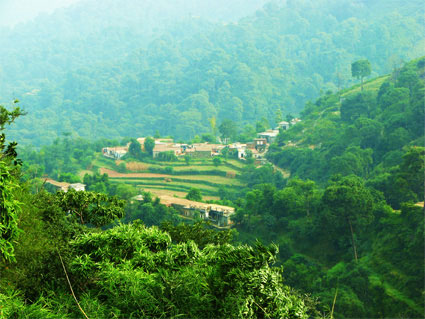
Hidden away in the Garhwal Himalayas is an enchanting valley. Read on to find out more about the famous Valley of Flowers. This could as well be the playground of the gods. Under a clear Himalayan sky, fringed by snowy peaks and glaciers, a lush meadow full of colourful flowers ripples under a gentle breeze. This is Uttarakhands famed Valley of Flowers. The Valley of Flowers, situated in the Garhwal Himalayas, was declared a National Park in 1982. Situated close to the Nanda Devi National Park, it is spread over an area of 87.50 sq. km. It essentially consists of a glacial stretch, known locally as the Bhyundar valley, that originates in the Tipra Glacier from Gauri Parbat. Forming a kind of basin, the region is walled in by the tall peaks of the Zanskar range on the north, and a deep ravine on the south. Naturally shielded from the cold winds blowing across the Tibetan plateau, as well as the monsoon laden winds from southern India, this region enjoys a unique climate. For much of the year, November to May, the valley is covered with snow, and inaccessible. Then around June, when the snow starts melting, the entire valley experiences a mass flowering that converts the stark landscape into a riot of colours. In this articleHistoryNatural WonderReligious SignificanceFact File History The Valley of Flowers was discovered in 1931 by the British mountaineer and botanist, Frank Smythe, while on an expedition to Mt. Kamet. Smythe returned there in 1937 on an expedition to study the flora of the region, and wrote a book, "The Valley of Flowers". It was Smyths book that gave this place its popular name. Natural Wonder Geographically, the Valley of Flowers represents an important transition between the Zanskar and the Great Himalayan mountain ranges. Apart from the amazing floral diversity, the region is also home to some rare animals. Flora The Valley of Flowers contains a phenomenal diversity of alpine plant life. Around 300 species of flowers grow here. Many of the species are endangered. Of these, some are endemic, which means that they grow only in this region and nowhere else. The valley contains more species of medicinal plants than are found anywhere else in the Himalayas. Primulas, potentillas, balsam, lilies, poppies, calendulas, daisies, geraniums, morinas, and wild roses are just some of the flowers that bloom here. Apart from the flowers, trees such as oak, blue pine and birch also grow here. These are some striking flowers that you could look for: Arum (Arisaema costatum): This plant, resembling a hooded cobra, grows in shady areas in the valley. Blue poppy (Meconopsis aculeate): This delicate, light bluish poppy with golden stamens stands solitary, usually in patches of meadow encircled by rocks and boulders. Ladys slipper orchid (Cypripedium himalaicum): These flowers often grow in profusion, painting the slopes with their rosy glow. Brahma Kamal (Saussurea obvallata): This beautiful cream coloured flower has petals that resemble a lotus, with brownish red stamens. It stands almost six to eight inches tall. It is rare and usually only found on the higher slopes of the valley. Fauna While these are not often visible, this area also supports some endangered Himalayan animals such as the Asiatic black bear, snow leopard, brown bear, Himalayan musk deer, blue sheep, and some rare species of birds. Religious Significance Many legends are woven around this enchanting valley. One is that the valley is `Nandan Kanan, the garden of Lord Indra. Another local belief is that this was the place from where Hanuman retrieved the magical herb, Sanjeevani, to revive Lakshman, an incident narrated in the epic, Ramayana. On the way to the Valley of Flowers, a five-km trek to the right leads to Hemkund, a beautiful lake at an altitude of 4, 329 metres, that is frozen for eight months in a year. Literally, lake of ice, Hemkund is considered holy by the Sikhs, who believe that Guru Gobind Singh meditated on these banks. Apart from Hemkund Gurudwara, a Lakshman temple has also been built on the banks of this lake. Fact File How to reach: Visitors can approach the Valley of Flowers from Govindghat, an hours drive from Joshimath. The nearest railhead is Rishikesh (289 km away), and the nearest airport is the Jolly Grant airport (306 km away). From Govindghat, a 14-km trek, by foot or mule takes you to Ghangria. The Valley is a three-km climb from Ghangria, which has to be made on foot. Best time to visit: Mid July to mid August Accommodation: The Garhwal Mandal Vikas Nigam offers accommodation at Joshimath. At Ghangria, the Garhwal Mandal Vikas Nigam Tourist Rest House offers rooms and space for tents. A Sikh Gurudwara and some local establishments also offer basic accommodation.
Hidden away in the Garhwal Himalayas is an enchanting valley. Read on to find out more about the famous Valley of Flowers. This could as well be the playground of the gods. Under a clear Himalayan sky, fringed by snowy peaks and glaciers, a lush meadow full of colourful flowers ripples under a gentle breeze. This is Uttarakhand's famed Valley of Flowers. The Valley of Flowers, situated in the Garhwal Himalayas, was declared a National Park in 1982. Situated close to the Nanda Devi National Park, it is spread over an area of 87.50 sq. km. It essentially consists of a glacial stretch, known locally as the Bhyundar valley, that originates in the Tipra Glacier from Gauri Parbat. Forming a kind of basin, the region is walled in by the tall peaks of the Zanskar range on the north, and a deep ravine on the south. Naturally shielded from the cold winds blowing across the Tibetan plateau, as well as the monsoon laden winds from southern India, this region enjoys a unique climate. For much of the year, November to May, the valley is covered with snow, and inaccessible. Then around June, when the snow starts melting, the entire valley experiences a mass flowering that converts the stark landscape into a riot of colours.
The Valley of Flowers was discovered in 1931 by the British mountaineer and botanist, Frank Smythe, while on an expedition to Mt. Kamet. Smythe returned there in 1937 on an expedition to study the flora of the region, and wrote a book, "The Valley of Flowers". It was Smyth's book that gave this place its popular name.
Natural Wonder
Geographically, the Valley of Flowers represents an important transition between the Zanskar and the Great Himalayan mountain ranges. Apart from the amazing floral diversity, the region is also home to some rare animals. Flora The Valley of Flowers contains a phenomenal diversity of alpine plant life. Around 300 species of flowers grow here. Many of the species are endangered. Of these, some are endemic, which means that they grow only in this region and nowhere else. The valley contains more species of medicinal plants than are found anywhere else in the Himalayas. Primulas, potentillas, balsam, lilies, poppies, calendulas, daisies, geraniums, morinas, and wild roses are just some of the flowers that bloom here. Apart from the flowers, trees such as oak, blue pine and birch also grow here. These are some striking flowers that you could look for:
Arum (Arisaema costatum): This plant, resembling a hooded cobra, grows in shady areas in the valley.
Blue poppy (Meconopsis aculeate): This delicate, light bluish poppy with golden stamens stands solitary, usually in patches of meadow encircled by rocks and boulders.
Lady's slipper' orchid (Cypripedium himalaicum): These flowers often grow in profusion, painting the slopes with their rosy glow.
Brahma Kamal (Saussurea obvallata): This beautiful cream coloured flower has petals that resemble a lotus, with brownish red stamens. It stands almost six to eight inches tall. It is rare and usually only found on the higher slopes of the valley.
Fauna While these are not often visible, this area also supports some endangered Himalayan animals such as the Asiatic black bear, snow leopard, brown bear, Himalayan musk deer, blue sheep, and some rare species of birds.
Religious Significance
Many legends are woven around this enchanting valley. One is that the valley is `Nandan Kanan', the garden of Lord Indra. Another local belief is that this was the place from where Hanuman retrieved the magical herb, Sanjeevani, to revive Lakshman, an incident narrated in the epic, Ramayana. On the way to the Valley of Flowers, a five-km trek to the right leads to Hemkund, a beautiful lake at an altitude of 4, 329 metres, that is frozen for eight months in a year. Literally, 'lake of ice', Hemkund is considered holy by the Sikhs, who believe that Guru Gobind Singh meditated on these banks. Apart from Hemkund Gurudwara, a Lakshman temple has also been built on the banks of this lake.
Fact File
How to reach: Visitors can approach the Valley of Flowers from Govindghat, an hour's drive from Joshimath. The nearest railhead is Rishikesh (289 km away), and the nearest airport is the Jolly Grant airport (306 km away). From Govindghat, a 14-km trek, by foot or mule takes you to Ghangria. The Valley is a three-km climb from Ghangria, which has to be made on foot. Best time to visit: Mid July to mid August Accommodation: The Garhwal Mandal Vikas Nigam offers accommodation at Joshimath. At Ghangria, the Garhwal Mandal Vikas Nigam Tourist Rest House offers rooms and space for tents. A Sikh Gurudwara and some local establishments also offer basic accommodation.
Sorry. Due to our site's regulations and policies, your message has not been posted. Our moderating team has been notified about your message. If the message is found to be genuine and still did not get posted, you may not post the message again as it will automatically get posted for you within 24hrs time (excluding weekends).
- The Indiaparenting Team
Valley of flowers is not only for nature lovers but for all people who love flowers. you will get to see many unique flowers and the beauty is sure to mesmerize you.
Have you heard about the Valley of Flowers? Do you enjoy trekking to places of natural beauty? Do you think tourism in the Himalayas threatens the delicate ecosystem in the region?
john silva
Daytona beach hotels also enables its guests to enjoy BEACH FRONT HOTEL FLORIDA outdoor activities like deep sea fishing charters, snorkeling ,surfing and sailing. Heaven on Earth...
Nell Dikson
Valley of Flowers India travel guide with latest information of Valley of Flowers Tourism. Best deals in Valley of Flowers tours travel packages, Plan your Valley of Flowers trip with securereservatio...
Priya
I visited Valley of Flowers in 2006. I have written a detailed review and the dos and dont for the trip on Mouthshut. Please do see it. ...