Drawing and painting takes out the inhibitions from within and helps a child express his thoughts. This activity encourages imaginative skills thus helping in motor skill development. Guide your child towards drawing and painting so that he is able to express his feelings freely. Here are some tips.The love for drawing and colours seems to come naturally to most of the children. Kids are fond of drawing and they love to scribble or make marks on paper or the walls of the house whenever they can lay their hands on a pencil or a crayon. It is rather easy to bring out this natural talent in your kid as you give him some easy tips on how to draw and paint. Then copying objects that they see around them like certain shapes, trees, houses or animals will come much, more easily. By helping your child to draw and paint you help them develop their inherent imagination skills and simultaneously better their motor skills by using their fingers and hands. Parents can help the child when they start scribbling by the age of twelve or fourteen months. Here are a few tips on how you can effectively guide your kid in drawing and painting: In this articleTeach the Kid How to Hold a CrayonTeach How to Draw Strokes on PaperRemove DistractionsTeach the Kid How to Hold a Crayon You need to ensure that the colour pencils or crayons do not have very sharp points which could harm and injure the kid. Kids have this tendency to put crayons and pencils in their mouth. You need to teach them that the purpose of the crayons is to draw and colour and they should be put into the mouth as it is unclean too. Make sure that you buy kid friendly crayons that are not toxic and where the chances of infections are comparatively less. Then teach them how to hold the crayon. Show them how they should wrap their fingers around the crayon and then start drawing. Teach them how to balance the crayon and then they will find it easier to sketch and draw. Teach How to Draw Strokes on Paper When the child is nearing two years, they are more able to draw proper strokes on paper. So this is the time that you teach them how to go about it. Start with up and down strokes and then after they get easy with these lines, gradually practice them across and circular strokes. This will lessen the scribbling and you will find the kid drawing more of neat straight lines. Encourage them to practice more and more. But at the same time, ensure that the practice does not become monotonous. Involve some fun games into the drawing session like say, conjoin it with the reading session or put in some music so that the child finds the whole activity interesting. Before long you will find them holding the crayon or pencil with their little fingers instead of the palms. The outlines of the trees, houses and the animals will begin to acquire a definite shape and become identifiable. As the grip develops, the shapes and figures will also develop simultaneously. Painting comes at a later stage when the child is mature enough to understand how he should use the brush and how to change brushes to adjust thickness of lines, or dilute colours. Once a child develops a firm grip with crayons or pencils he will be able to readily adjust with the brushes and water colours. Remove Distractions While you try to make drawing, sketching, colouring and painting a fun activity, ensure that the child is not distracted. If you are putting on music, it should just be a background harmony that will not grab his attention away from the primary work that he is doing. And do not put the television on when your kid is drawing. This can prove to be the biggest distraction. Perhaps the most basic point while you try to teach drawing and painting to your child is, you should teach him to observe the world around him. This should start at a very early age, right when he is an infant when you take him out for a walk in the garden or around the house; you point things out to him and teach the simple characteristics of those objects. This will give a good understanding of shapes and colours and he will have a better idea of the object that he is putting down on paper.
Drawing and painting takes out the inhibitions from within and helps a child express his thoughts. This activity encourages imaginative skills thus helping in motor skill development. Guide your child towards drawing and painting so that he is able to express his feelings freely. Here are some tips.The love for drawing and colours seems to come naturally to most of the children. Kids are fond of drawing and they love to scribble or make marks on paper or the walls of the house whenever they can lay their hands on a pencil or a crayon. It is rather easy to bring out this natural talent in your kid as you give him some easy tips on how to draw and paint. Then copying objects that they see around them like certain shapes, trees, houses or animals will come much, more easily. By helping your child to draw and paint you help them develop their inherent imagination skills and simultaneously better their motor skills by using their fingers and hands.
Parents can help the child when they start scribbling by the age of twelve or fourteen months. Here are a few tips on how you can effectively guide your kid in drawing and painting:
You need to ensure that the colour pencils or crayons do not have very sharp points which could harm and injure the kid. Kids have this tendency to put crayons and pencils in their mouth.
You need to teach them that the purpose of the crayons is to draw and colour and they should be put into the mouth as it is unclean too. Make sure that you buy kid friendly crayons that are not toxic and where the chances of infections are comparatively less.
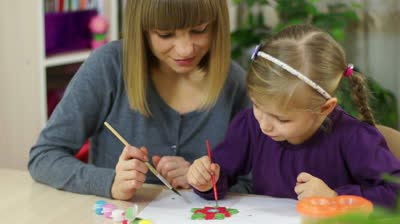
Then teach them how to hold the crayon. Show them how they should wrap their fingers around the crayon and then start drawing. Teach them how to balance the crayon and then they will find it easier to sketch and draw.
Teach How to Draw Strokes on Paper
When the child is nearing two years, they are more able to draw proper strokes on paper. So this is the time that you teach them how to go about it.
Start with up and down strokes and then after they get easy with these lines, gradually practice them across and circular strokes. This will lessen the scribbling and you will find the kid drawing more of neat straight lines. Encourage them to practice more and more.
But at the same time, ensure that the practice does not become monotonous. Involve some fun games into the drawing session like say, conjoin it with the reading session or put in some music so that the child finds the whole activity interesting.
Before long you will find them holding the crayon or pencil with their little fingers instead of the palms. The outlines of the trees, houses and the animals will begin to acquire a definite shape and become identifiable. As the grip develops, the shapes and figures will also develop simultaneously.
Painting comes at a later stage when the child is mature enough to understand how he should use the brush and how to change brushes to adjust thickness of lines, or dilute colours. Once a child develops a firm grip with crayons or pencils he will be able to readily adjust with the brushes and water colours.
Remove Distractions
While you try to make drawing, sketching, colouring and painting a fun activity, ensure that the child is not distracted. If you are putting on music, it should just be a background harmony that will not grab his attention away from the primary work that he is doing. And do not put the television on when your kid is drawing. This can prove to be the biggest distraction.
Perhaps the most basic point while you try to teach drawing and painting to your child is, you should teach him to observe the world around him. This should start at a very early age, right when he is an infant when you take him out for a walk in the garden or around the house; you point things out to him and teach the simple characteristics of those objects. This will give a good understanding of shapes and colours and he will have a better idea of the object that he is putting down on paper.
Sorry. Due to our site's regulations and policies, your message has not been posted. Our moderating team has been notified about your message. If the message is found to be genuine and still did not get posted, you may not post the message again as it will automatically get posted for you within 24hrs time (excluding weekends).
- The Indiaparenting Team
Do you encourage your preschooler to scribble? Does your preschooler have an inclination towards drawing and painting? How can you unleash the imaginative power of your child?
sneha
Drawing & painting is an extra ordinary talent or activity of kids. It´s the best way of improving children´s imaginary skill & motor skill & mental agility. Some kids love to do painting & ...
My daughter loves to scribble in any free space she finds. she scribbles on walls, bedsheets and anything. I do not like this habits of hers so I scold her and told her not to do. now she has stopped ...
you should not have scolded your daughter for such a small issue. Rather you could have explained her your point of view. I do not think that you did the right thing. you have in a way frightened her ...
RE:What Toddlers Should Be Learning?
Toddlers are at a crucial stage of learning, where foundational skills for ... - Fabienread >>
RE:How to Find Right Preschool or Nursery
Every parent wants to admit their child to the best preschool as it is an i ... - PodarPrepread >>
Buy Real Passport Online https://worldpassporte.co
worldpassporte . c o m We are specialists in the production of real databas ... - Jobclif Jobclifread >>
Buy Real Passport Online https://worldpassporte.co
worldpassporte . c o m We are specialists in the production of real databas ... - Jobclif Jobclifread >>