Has you baby just started crawling and picking-up things lying helter-skelter? If yes, then it is a time to childproof your house. Read on to know more about the childproofing essentials for a house with an infant.Every home is unique and the things required for childproofing may not always be the same for all homes. However broadly there are certain precautions which every household with an infant must adopt. Here is a baby checklist which parents can make use of while childproofing their house. Needless to say nothing is comparable to the watchful eyes of the parents or adult care givers in the house. The purpose of this checklist is to serve as a guide and put parents at ease by reducing or preventing any harm from coming in way of the infant as far as possible. In this articlePower Strip CoversLocks for CabinetsGatesFaucet Covers for the BathtubCorner GuardsBanister Rail NetsFurniture StrapsList of Childproofing Must Haves This list is in no particular order of importance. Each and every aspect is as important as the other: Power Strip Covers Home childproofing should start with covering power points. Infants invariably out of curiosity head for the power points. Inserting a finger in a powered point can result in electrocution. Power strip covers are available in plenty of designs all of which work well to serve the purpose for which they are designed. Locks for Cabinets Often we store things in cabinets which must remain out of reach of infants. To achieve this it is best to keep the cabinets locked. Cabinet locks are available in shapes and sizes of all kinds. Make use of locks with keys which will make it almost impossible for the baby to access it even after she grows up a little. Gates Baby gates can be used to restrict the entry or exit of a baby into particular areas of the house. Gates are very versatile and can be used all over the house - indoors as well as outside. For example in a home with a newborn, one can be installed outside the house at the top of the deck stairs and another one to block the hallway which serves as an entrance point to the utility room. In many homes kitchen garbage is kept on the outer side of baby gates gate to ensure that it remains out of reach of the infant. Gates are available in all sizes and the best baby gates are the ones that are designed to open like a gate. Such gates are very easy and convenient to cross whenever required by adults. Gates normally come with a locking handle on the top or a foot pedal lock at the bottom. Both these types of gates serve the purpose of restricting entry and you can choose any one based on your preference. Faucet Covers for the Bathtub These are normally rubber covers which are shaped like an animal or other kid friendly object. These can easily be slid over the part of the faucet where the water comes out making it soft to the touch. Faucet covers basically protect infants from bumping their heads or falling on the hard faucet and hurting themselves. Corner Guards Corner guards are small pieces of rubber which fit over the corners of just about anything. If you look around closely, you will be able to identify a number of corners in your home which you need to keep covered to ensure that your infant does not bump into and hurt herself. Corner guards are available in precut specific sizes or as rolls of soft foam which can easily be cut in different sizes and shapes. Banister Rail Nets These are very useful in houses where there are stairs. Irrespective of whether the stairs is outside on the deck or a staircase leading to the second storey, railing nets are a must if you have an infant at home. Nets are used to mount over the inside of the rail which keeps small children from putting their head, arms or legs through. Furniture Straps Infants and toddlers fancy climbing TVs, tall dressers, entertainment centers and other types of furniture. By making use of furniture straps you will be able to attach big pieces of furniture to the wall and ensure that it does not fall even if your toddler attempts to climb it. In addition to the above there may be many more things which you may require specifically for childproofing your house. To ensure total infant safety it is best to look around your house carefully and identify all potentially unsafe objects or locations which can cause harm to your baby. By making a list of such objects and locations you will be able to take steps to systematically childproof your house and keep your infant safe.
Has you baby just started crawling and picking-up things lying helter-skelter? If yes, then it is a time to childproof your house. Read on to know more about the childproofing essentials for a house with an infant.Every home is unique and the things required for
childproofing may not always be the same for all homes. However broadly there are certain precautions which every household with an infant must adopt. Here is a baby checklist which parents can make use of while childproofing their house.
Needless to say nothing is comparable to the watchful eyes of the parents or adult care givers in the house. The purpose of this checklist is to serve as a guide and put parents at ease by reducing or preventing any harm from coming in way of the infant as far as possible.
List of Childproofing Must Haves
This list is in no particular order of importance. Each and every aspect is as important as the other:
Power Strip Covers
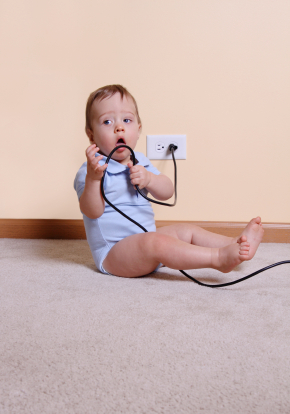
Home childproofing should start with covering power points. Infants invariably out of curiosity head for the power points. Inserting a finger in a powered point can result in electrocution. Power strip covers are available in plenty of designs all of which work well to serve the purpose for which they are designed.
Locks for Cabinets
Often we store things in cabinets which must remain out of reach of infants. To achieve this it is best to keep the cabinets locked. Cabinet locks are available in shapes and sizes of all kinds. Make use of locks with keys which will make it almost impossible for the baby to access it even after she grows up a little.
Gates
Baby gates can be used to restrict the entry or exit of a baby into particular areas of the house. Gates are very versatile and can be used all over the house - indoors as well as outside. For example in a home with a newborn, one can be installed outside the house at the top of the deck stairs and another one to block the hallway which serves as an entrance point to the utility room.
In many homes kitchen garbage is kept on the outer side of baby gates gate to ensure that it remains out of reach of the infant. Gates are available in all sizes and the best baby gates are the ones that are designed to open like a gate. Such gates are very easy and convenient to cross whenever required by adults. Gates normally come with a locking handle on the top or a foot pedal lock at the bottom. Both these types of gates serve the purpose of restricting entry and you can choose any one based on your preference.
Faucet Covers for the Bathtub
These are normally rubber covers which are shaped like an animal or other kid friendly object. These can easily be slid over the part of the faucet where the water comes out making it soft to the touch. Faucet covers basically protect infants from bumping their heads or falling on the hard faucet and hurting themselves.
Corner Guards
Corner guards are small pieces of rubber which fit over the corners of just about anything. If you look around closely, you will be able to identify a number of corners in your home which you need to keep covered to ensure that your infant does not bump into and hurt herself. Corner guards are available in precut specific sizes or as rolls of soft foam which can easily be cut in different sizes and shapes.
Banister Rail Nets
These are very useful in houses where there are stairs. Irrespective of whether the stairs is outside on the deck or a staircase leading to the second storey, railing nets are a must if you have an infant at home. Nets are used to mount over the inside of the rail which keeps small children from putting their head, arms or legs through.
Furniture Straps
Infants and toddlers fancy climbing TVs, tall dressers, entertainment centers and other types of furniture. By making use of furniture straps you will be able to attach big pieces of furniture to the wall and ensure that it does not fall even if your toddler attempts to climb it.
In addition to the above there may be many more things which you may require specifically for childproofing your house. To ensure total infant safety it is best to look around your house carefully and identify all potentially unsafe objects or locations which can cause harm to your baby. By making a list of such objects and locations you will be able to take steps to systematically childproof your house and keep your infant safe.