Egg Donation is a process used in an assisted reproduction technique. Females donate their when it is not possible for a woman to produce healthy eggs for the process of
fertilisation and reproduction. There are certain steps that are carried out in an egg donation process.
The Normal Menstruation Cycle is Stopped
Once a woman is chosen as an egg donor, certain medications are prescribed for a couple of weeks in order to stop the normal functioning of the ovaries. This is done so as to ensure a positive response to the fertility drugs that are to be administered to the woman. Usually the woman is taught how to inject the medicine at home by herself.
Probable Risks The woman can experience fatigue, headache, body ache, hot flushes, dryness in her vagina, mood swings, sleep disorders, tenderness in her breasts and some women have also reported vision problems.
Egg Production is Stimulated
First let us describe what happens in a normal menstrual cycle. During the ovulation period, one egg matures and is released into the ovary from the sac that had been the container of the egg, known as the follicle.
Now what happens in the egg donation process? Here the physician collects several mature eggs from the woman. This makes it necessary to prescribe certain medications that stimulate the ovaries. Medically the process is termed as hyper-stimulation where a number of mature eggs that are above the normal number are produced. The medication used for this purpose is akin to the hormones that are naturally produced by the body, but here the amount is certainly much more.
The treatment commences on a particular day of the cycle and continued for about ten days.
The Probable Risks The area around the skin where the injection is pushed through might experience redness and soreness. The skin shows mild bruises also. The other probable risks are tenderness in breasts, mood swings, enlargement of the ovaries and some women also experience mild retention of fluids. This is actually caused by the over stimulation of the ovaries. There can also be abdominal pain caused by pressure and swelling. Usually these symptoms fade away by the time of the next menstrual cycle.
During this stimulation process, the egg donor should be under careful monitoring and drugs that provide comfort for the excessive pain should be prescribed. The woman must also be under complete bed rest.
In rare cases there can be fatal consequences like blood clotting, kidney failure, shock and dangerous fluid buildup in the lungs. If the symptoms go beyond control one or both the ovaries might be required to be removed. Allergic reactions to fertility drugs are but rare.
Progress is Monitored
Blood tests and ultrasound exams are conducted at regular intervals during the donation cycle. This tracks how the woman responds to the prescribed hormones and how the egg development is taking place. The dose of medication is adjusted accordingly. When the eggs are sufficiently matured, the final injection is prescribed to aid the egg retrieval process.
Probable Risks Frequent blood drawing can enhance the discomfort and result is bruises in the area. Ultrasound can add to the discomfort but does not have any associated risks.
Egg Removal
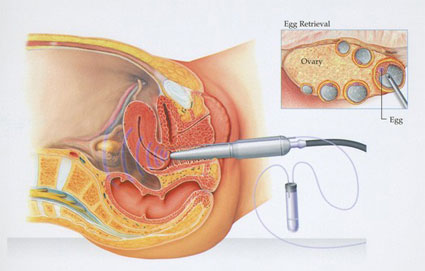
The mature eggs are removed through a minor surgery called Trans Vaginal Ovarian Aspiration. This is done through the insertion of an ultrasound probe in to the vagina of the woman. The probe has a thin needle attached to it which is inserted inside the follicle. Then through a suction process, the egg and the liquid inside the follicle is removed. The process takes around 30 minutes. The recovery period is few hours.
Probable Risks - During the insertion of the needle there can be bleeding. The bowel, bladder and nearby blood vessels and other pelvic organs might be damaged in some cases which can be rectified by another abdominal surgery.
- Possible infections are treated with antibiotics.
- In certain cases it has been found that the egg donor’s fertility might be negatively affected.
After the mature eggs are removed, they are taken through In Vitro Fertilisation Process (IVF). In this process eggs and sperms are allowed to meet so that the fertilisation takes place. These fertilised eggs are then planted in the uterus to grow into a pregnancy.