Haemorrhoids can affect any person, any time. They are of common occurrence. There are different causes of haemorrhoid. Read on to know about the causes.What causes haemorrhoids?
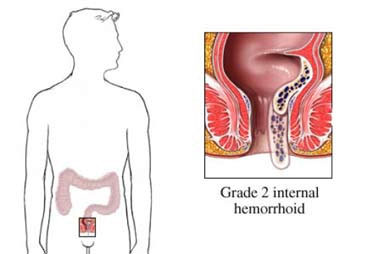
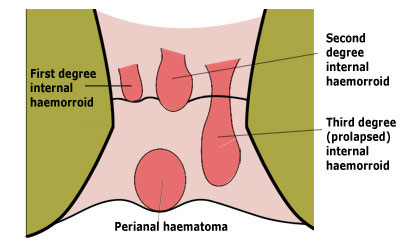
Haemorrhoids, which are normal structures present at the upper part of the anal canal, are supported by two tissues. Constant pressure on this tissue (for example, straining when constipated or due to age) tends to degenerate the tissue. As a result the haemorrhoids tend to distend. Because of lack of support the haemorrhoids become swollen (like a balloon filled with water) and are now sensitive to injury. Constant rubbing by the hard faecal matter leads to bursting of the capillaries and thus leads to bleeding. As the condition progresses, the connective tissue ruptures and the haemorrhoids become permanently protruded.
What kind of person is most at risk?
Haemorrhoids are one condition that can affect any person at any time. Poor eating habits, irregular bowel movement, frequent changes in lifestyle, excessive travel, prolonged standing or sitting, etc. can all contribute to contracting haemorrhoids. Persons coping with following conditions may suffer with haemorrhoids.
Constipation
Straining during constipation puts pressure on the veins, which either bleed or protrude outside the rectum.
Pregnancy
Pregnancy is a common cause for
haemorrhoids in women. There is increased pressure in the veins due to the enlarging womb and increased blood volume.
Standing or Sitting for a Long Period
People who tend to stand (for e.g., teachers, factory workers) or sit (for example, office workers) for long periods tend to accumulate blood in the veins, which can lead to haemorrhoids.
Overweight
Being overweight puts extra pressure on the haemorrhoidal veins.
Chronic Diarrhoea
Haemorrhoids can also be caused due to chronic diarrhoea. Due to chronic diarrhoea stools are passed frequently and the area needs to be washed or wiped over and over again. The haemorrhoidal veins get constantly rubbed due to passage of stools as well as washing or wiping of the area. Due to this problem the haemorrhoidal veins may get swollen and start bleeding.
Anal Sex
Bad or improper anal sex can cause chronic abdominal strain as well as chronic anal irritation which are primarily responsible for haemorrhoids.
Faulty Diet
Faulty eating habits and following a faulty diet can cause haemorrhoids. Especially, the diet which lacks fibrous foods can be a cause of haemorrhoids. Lack of fruits and vegetables in diet, eating junk foods and including more of foods made-up of refined flour can cause stools to harden and lead to problems like haemorrhoids.
Inadequate Intake of Water
Inadequate intake of water can also be responsible for haemorrhoids. Inadequate intake of water may result in hardening of stools. When stools are hardened pressure is exerted on the haemorrhoidal veins thereby causing them to swell and burst.
Intake of Alcoholic or Caffeinated Drinks
Excessive intake of
alcohol or caffeinated drinks which may lead to loss of water from body may result in dehydration thereby causing haemorrhoids.
How to prevent haemorrhoids?
Here is what one can do to
prevent haemorrhoids.
Emptying Bowel on Feeling the Urge
Holding bowel movements can cause stools to harden. Therefore, it is a must to empty the bowel when the urge is felt.
Drinking Adequate Amount of Water
Drinking adequate amount of water is a must to prevent problems like haemorrhoids. It is a must to drink at least 3 to 4 litres of water a day.
Avoiding Alcoholic and Caffeinated Drinks
It is a must to avoid taking alcoholic and caffeinated drinks which cause loss of water from body causing haemorrhoids.
Avoiding Long Hours of Sitting or Standing
Avoid sitting or standing for long hours in one place. Take small breaks in between. You can get-up from your place, take a round and come back to your place again. In this way, accumulation of blood in the haemorrhoidal veins can be avoided.
If you have marked any of the
symptoms of haemorrhoids, it is necessary to consult a doctor so that he or she can suggest appropriate measures to deal with the condition.