Breast feeding the baby soon after delivery is a must. Colostrum, the yellowish milk produced by the mother is most important for the baby as it is rich in nutrients. Breast fed babies are more healthy and they seldom fall sick. Here are some tips for successful breastfeeding.
You should begin breastfeeding your baby an hour after delivery.
Colostrum, the yellowish milk produced by the mother in the first 3 days, is very healthy for the child.
The baby does not need anything other than breast milk for the first 4-6 months of life. Breast milk provides adequate nutrition and immunity for the baby.
A baby who has only breast milk (no additional water), and urinates a minimum of 6 times in 24 hours is getting enough breast milk.
There is no need to worry about frequent watery motions in an exclusively breastfed baby, as long as the baby is active and passes urine adequately.
Your baby should be free to breastfeed whenever and for as long as she chooses. More suckling means more breast milk. Demand feeding alleviates breast engorgement and breast infection.
It is important that the baby not only get foremilk (rich in carbohydrates, vitamins and proteins, that also helps quench the baby's thirst), but also get hind milk (rich in fat and calories). Therefore, you should allow the baby to keep suckling from one side until he leaves the breast on his own, so that he gets enough hindmilk.
Try to avoid bottle-feeding entirely. It is not necessary at all.
Bottle-feeding may be a direct cause for breastfeeding failure.
If the baby cannot tolerate bottle-feeding or artificial feeding, it can lead to a serious illness.
Knowing the basics of breastfeeding
Positioning:
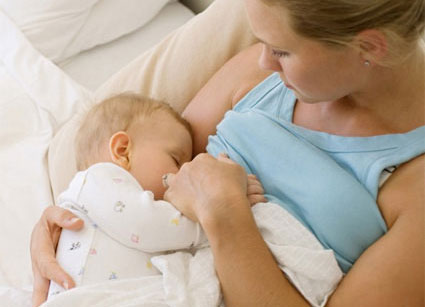
The baby should be unwrapped before being put to the breast. This will allow her the freedom to feel her mother's body, especially her warm breasts. She must be positioned such that she is in a semi-upright position with her stomach touching your stomach, her lower shoulder touching you, and her upper shoulder close to your breast.
Latching on:
She must take the entire nipple (the dark areola) in her mouth. If she is still very young and has a small mouth, it is more important that her lips cover the lower part of the areola than the upper part of the areola. It is her lower jaw that will do all the suckling.
Timing and Frequency of Feeds:
She must be allowed to feed as often and as long as she wants (including during the night). This will ensure that she gets enough hindmilk, and also a feeling of security.
Ban on Feeding Bottles:
Although you may have got many feeding bottles as gifts, it is important that you never use them. The use of feeding bottles could cause nipple confusion and result in breastfeeding failure.
Sorry. Due to our site's regulations and policies, your message has not been posted. Our moderating team has been notified about your message. If the message is found to be genuine and still did not get posted, you may not post the message again as it will automatically get posted for you within 24hrs time (excluding weekends).
- The Indiaparenting Team
this is very good information.i think your number six tip is very important. your baby should be able to feed as often and as long at the breast as he chooses. parents should not be concerned about timing the feeds. let the baby be the guide. a satisfied baby will let go of the nipple and appear relaxed.
i am due to have a baby in a few weeks time and i want to exclusively breastfeed my baby.
i am told that the milk may not come in immediately and may take a couple of days, how does the baby remain hungry till then?
could someone pls answer my question
i just had my baby 2 1/2 weeks ago. my milk didn't come in well until about day 7. i also have very little colostrum. i avoided giving the glucose(sugar) bottle the first two days like all the breastfeeding info says to do and my baby started losing too much weight and had a rather bad case of jaundice. he needed the water to clean the bile out of his kidneys and the sugar to be healthy. day 3 in the hospital i started giving him the glucose solution after he had nursed some. this was to help my milk to come in and my uterus to shrink back down. he has never had nipple confusion. i also had to supplement the breast feeding with a bottle of hypo-allergenic formula until my milk was coming in well. don't feel guilty if you need to do the same. just nurse first until the baby starts fussing because he/she isn't getting any milk, switch breasts until it happens again and then finish them off with a bottle. i had to do this for only about 3-4 days after coming home. i know may books say your milk comes in after 3 days, but many mothers i've spoken to have said it was more like 1-2 weeks for plenty to feed their babies. i use the advent bottles which are supposed to be more like the mother's nipple. i also have to us a nuk silicone nipple cover/extender since my son's lower lip is usually tucked back under his upper lip pretty far...like his dad! that helps him latch on and may also help prevent the nipple confusion since it may feel similiar to the bottle nipple. i also never wake him up in the night to feed. if he's hungry he lets me know. loudly! so we have been blessed to sleep almost every night about 5-6 hours since we use him to go to bed and wake up by. he usually finishes the last meal at 2300 and then wants breakfast 0600 after getting a new diaper. good luck! i hope this helps.
i have been breasfeeding my baby for three months and i would like to stop on the sixth month. do you have any tips or information on how i can start my baby on formula?
i have a 7weks old baby who is compleatly breast fed but while i am feeding on one side he tends to fall asleep if i donn't change sides before he leaves the breast.thus not been able to feed on both sides at one time ever..my baby is absolutely healthy but is it ok to feed on one side at a time?
i dont think it is fair or wise to say women should never use bottles. everyones situation is different. breastfeeding is healthy but when taht is not an option or mom does not want to do it then they use the bottle.formulas woul not be on the market if they were not healthy also.what about a mother who has to return to work after a short period of time?answer that