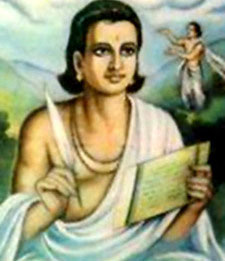
Kalidas is considered to be one of the greatest Indian literary personalities of all time, and his works form the cornerstone of Indian mythology. Little is known about his personal life, but legends abound. He is known to be familiar with Greek Astronomy, and has used a few Greek terms in his work. According to one such popular legend, Kalidas wasn't always so wise and learned. In fact, there was a time he was considered to be one of the stupidest people in the kingdom!
One sunny day, Kalidas was sitting on a branch of a tree, trying to saw it off. But the dimwitted man was sitting on the wrong end of the branch, so when he finally sawed through the branch, down he tumbled! This act of sheer stupidity was observed by some shrewd pundits minister passing by.
Now these pundits wanted to play a trick on the arrogant princess, to teach her a lesson. She was determined to marry someone who would defeat her in a debate about the scriptures. The princess had heaped considerable abuse on them over a period of time, and they were determined to extract their revenge. So, when they chanced upon Kalidas, they decided to present him to the queen as a suitable match for her.
In order to conceal his stupidity, the pundits asked Kalidas to pretend that he was a great sage, who was observing a vow of silence. Kalidas readily agreed, and they presented him to the queen, saying that Kalidas would only communicate by way of gestures. When the queen asked Kalidas a few questions to test his intelligence, Kalidas gesticulated wildly and the astute pundits 'interpreted' these gestures as extremely witty answers and retorts. The princess was suitably impressed, and the couple was married without much delay.
Kalidas's stupidity could be concealed for only so long, and the night of the wedding Kalidas blurted out something inane. The princess realized that she had married a prize fool. Furious, she threw him out of her palace, and her life.
The dejected Kalidas wandered around, till he came to the bank of the river. He contemplated taking his life when he suddenly saw some women washing clothes on the edge of the river bank. He observed that the stones which the women were pounding with clothes, were smooth and rounded, while the other stones were rough and ragged. This observation hit him like a thunderbolt, and it dawned upon him that if stones could be worn through and change their shape by being pounded upon by clothes, then why couldn't his thick brains change, by being pounded upon by knowledge!
Kalidas thus grew determined to become the wisest and most learned man in the country, and to achieve this end he started indulging in intellectual pastimes, reading, meditating and praying to his goddess Kali to grant him divine knowledge. His wish was fulfilled.
Kalidas's contribution to Indian literature is tremendous. Though his writings were in Sanskrit, they have been translated into numerous languages. While numerous writings have been attributed to him, only seven works are proved to be genuinely his.
Malavikaagnimitra (Malavikaa and Agnimitra)
Vikramorvashiiya (The story of Urvashi and Pururavas)
Abhigyanashakuntala (Shakuntala)
Of these plays, Kalidas is best known for the play Shakuntala, which has gone on to receive worldwide attention. Shakuntala was first translated into English, then into German, and then into several other western languages. The other four works were poems.
Sorry. Due to our site's regulations and policies, your message has not been posted. Our moderating team has been notified about your message. If the message is found to be genuine and still did not get posted, you may not post the message again as it will automatically get posted for you within 24hrs time (excluding weekends).
- The Indiaparenting Team












 Kalidas is considered to be one of the greatest Indian literary personalities of all time, and his works form the cornerstone of Indian mythology. Little is known about his personal life, but legends abound. He is known to be familiar with Greek Astronomy, and has used a few Greek terms in his work. According to one such popular legend, Kalidas wasn't always so wise and learned. In fact, there was a time he was considered to be one of the stupidest people in the kingdom!